
DTBC Welcomes LGU Delegates of EU-PH Green Economy Partnership for Circular Waste Management Benchmarking
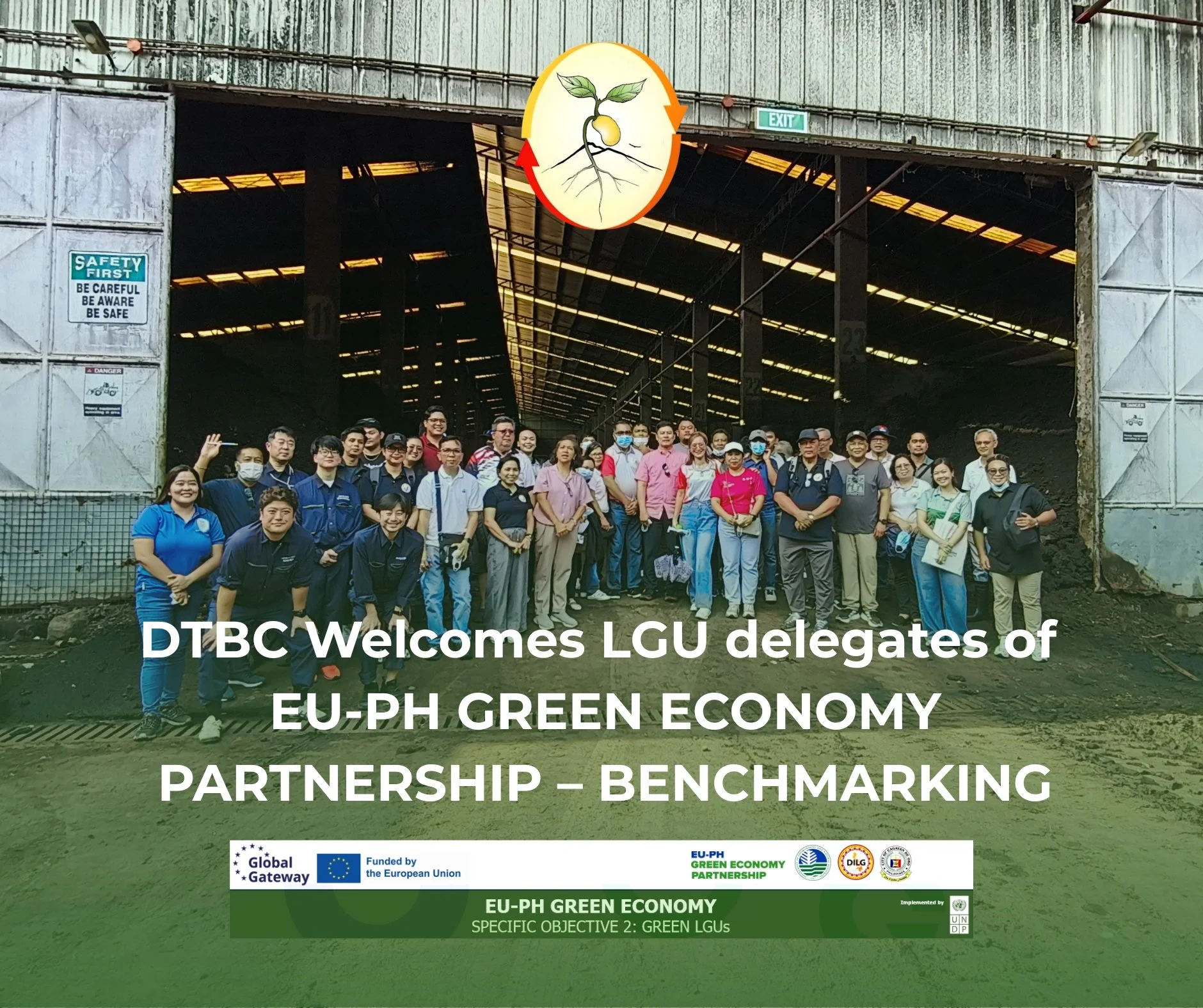
Representatives from the local governments of Maasin, Ormoc, Ilagan, Del Carmen, Isabela City, and BARMM, with Davao City LGU as host, together with key implementation partners of the EU-PH Green Economy Partnership, explored DTBC industrial composting facility in Binugao, Toril, Davao City.
The initiative is led by the Department of Environment and Natural Resources, implemented by the United Nations Development Programme in the Philippines, and co-led by the Department of the Interior and Local Government.
June 9, 2026 | DTBC Composting Plant, Binugao, Toril, Davao City
Davao Thermo Biotech Corp. welcomed local government delegates of the EU-PH Green Economy Partnership – Green LGUs Project for a benchmarking visit at the DTBC Composting Plant in Binugao, Toril, Davao City on June 9, 2026.
The visit brought together representatives from the local governments of Maasin, Ormoc, Ilagan, Del Carmen, Isabela City, LGUs in BARMM, and Davao City LGU as host, together with key implementation partners of the EU-PH Green Economy Partnership. The initiative is led by the Department of Environment and Natural Resources, implemented by the United Nations Development Programme in the Philippines, and co-led by the Department of the Interior and Local Government.
The benchmarking activity gave participating LGUs a closer look at how industrial-scale composting can support local circular economy efforts, especially at a time when many communities across the country continue to face mounting waste management challenges, overcapacity in landfills, and increasing environmental pressure from conventional disposal systems.
Seeing Circular Waste Management in Action
The exposure visit was led by DTBC Chief Executive Officer Ms. Olive Puentespina, who guided the delegates through DTBC’s composting facility and answered questions on the company’s technology, operational model, treatment process, and circularity approach.
During the visit, the LGU representatives observed DTBC’s DENR-EMB-accredited facilities and operations, including its capabilities as a holder of both Treatment, Storage, and Disposal accreditation and Transporter Registration Certificate. The delegates were also introduced to the facility’s wastewater treatment system, which forms part of DTBC’s environmental safeguards to help ensure that its operations do not adversely affect groundwater and nearby water systems.
For many of the visiting LGUs, the tour provided a practical view of how biodegradable waste can be professionally collected, transported, treated, and transformed into a useful circular output instead of being treated merely as a disposal burden.
A Technology Developed for Clean and Sustainable Processing
DTBC showcased its use of hyperthermophilic aerobic composting technology, a Japanese-patented process designed to convert biodegradable waste into a clean, safe, and valuable soil product through high-temperature composting.
Representatives from Kyowa Kako of Japan, DTBC’s technology partner and the principal developer of the technology, were also present during the visit. Their participation provided the LGU delegates with deeper technical insights on how the technology works and how similar systems may be configured or scaled depending on the needs of local governments.
The discussion was especially relevant because many LGU participants shared that their own cities and municipalities face different forms of waste management difficulty. These include limited disposal options, growing volumes of biodegradable waste, landfill pressure, and the need for more sustainable and locally appropriate treatment systems.
Through the site visit, DTBC demonstrated that biodegradable waste management can move beyond collection and disposal. With the right technology, governance support, and private sector partnership, organic waste can be converted into a resource that contributes to soil restoration, food production, and circular community development.
Private Sector Partnership for Green LGUs
The EU-PH Green Economy Partnership’s Specific Objective 2, also known as Green LGUs, is a major initiative that supports local governments in transitioning toward circular economy practices. It aims to help LGUs scale up sustainable waste management, attract green investments, and promote social inclusion.
For DTBC, the benchmarking visit reaffirmed an important message: sustainable waste management and circularity are possible when government and the private sector work together.
Local governments carry the mandate to protect communities, manage waste, and safeguard the environment. Private sector innovators, meanwhile, can contribute tested technologies, operational systems, investment models, and practical experience. When these strengths are combined, circular economy becomes less abstract and more achievable.
As the country continues to confront the consequences of overburdened landfills and unsustainable disposal practices, partnerships between LGUs and circular economy enterprises will become increasingly important.
Toward Circular Communities
DTBC’s work began with a clear environmental purpose: to transform biodegradable waste into regenerative bioproducts through biotechnology. Today, that purpose has expanded into a broader biocircular mission — helping households, institutions, farms, and local governments see biodegradable waste not as a problem to bury, but as a resource that can be recovered, restored, and returned to life.
The June 9 benchmarking visit served as an important platform for shared learning among LGUs, development partners, technology providers, and circular economy practitioners.
For DTBC, welcoming the Green LGUs delegation was not only an opportunity to present its facility. It was also an opportunity to show that circularity can be implemented, scaled, and localized.
With the right partnerships, biodegradable waste can be diverted from landfills, transformed into soil solutions, and used to help build cleaner, more resilient, and more circular communities.
From waste to soil, and from soil to life — DTBC continues to advocate for a waste-free and sustainable Philippines.